Overview
The world of artificial intelligence is evolving at a blistering pace, and this week brought a new wave of innovations, predictions, and unexpected launches from some of the biggest names in tech. From Elon Musk’s provocative forecaststo game-changing tools released by Google and industry-shifting developments in autonomous agentsthese milestones are already reshaping how we work, create, and think about the future. Let’s break down the top AI shifts you need to know now.
1. Google Unveils Game-Changing Free Design & Coding Tools
Google made headlines with two major product releases: Google AI Studio and Stitch 2.0. These tools are designed to streamline the process from idea to app launch:
- Google AI Studio transforms coding by allowing users to describe their vision, then automatically generating full-stack code. In the demo, a single prompt generated an entire 3D multiplayer racing gamelobby, room codes, real-time playwithout a single line of manual code.
- Stitch 2.0 brings “vibe design” to the forefront. Users simply describe how they want their app to look, or even talk to Stitch with their voice, and it builds a clickable prototype. Stitch applies a design system to all screens and lets you customize layouts by voice. You can even paste the URL of an existing sitelike Apple.comand have Stitch replicate its design language across your app in seconds.
The real magic happens when you combine these tools: design with Stitch, bring your design into AI Studio, and code everything to app-ready statusoften in under an hour. This dramatically reduces development time and cost, making high-quality, bespoke apps accessible to anyone who can describe their idea.
2. Elon Musk’s Two Stunning AI Predictions
At the recent Abundance Summit, Elon Musk delivered two predictions that stirred both excitement and debate:
- AI Will Run Out of Things to Make. As AI and robotics increasingly produce both goods and services, the idea of scarcity evaporates. According to Musk, shortageswhether for physical goods, services, or digital productswill simply cease to exist thanks to limitless AI productivity.
- The Global Economy Will 10x in 10 Years. Musk described a “fairly comfortable” scenario in which, barring global conflict, the world economy could expand tenfold in a decade, fueled by AI-driven growth.
While these statements sound radical, the advancements we’re seeing, such as autonomous AI agents and app-building technologies, make them increasingly plausible.
3. Manners & the Race for Personal AI Agents
Following Meta’s recent $2 billion acquisition, the AI agent company Manners released “My Computer”a desktop agent that can manage files, photos, build apps from prompts, and integrate seamlessly with your workflow. This trend is sweeping the industry, with companies like Claude, Perplexity, and Open Claw all racing to implant their own AI agents directly onto user devices. The paradigm is shifting from ‘having tools’ to ‘having digital colleagues that autonomously manage your work.’
4. Lovable, Gamma & the New Definition of Productivity Tools
Lovable, formerly known for no-code app generation, expanded into a full-suite business co-founder. You can now perform market research, generate pitch decks, and create promotional assetsall in a single chat. The key difference? Lovable doesn’t just provide information or advice; it delivers finished, ready-to-use assets.
Gamma, a presentation platform, made its mark by rebranding “presentations” as “gammas” and introducing on-brand, AI-generated creative assetsfrom logos to infographicsat the click of a button. By integrating with top AI models like Claude and GPT, Gamma is redefining what business storytelling tools can do.
5. Google’s Quiet Move Toward Personal Intelligence
Google is quietly rolling out “personal intelligence” in search across the US. By reading data from your Gmail, photos, purchases, and location, Google now proactively answers questions specific to your lifedown to suggesting meals during airport layovers based on your travel and eating preferences. Useful, powerful, and a little unsettling, this integration marks a new era of personalized AI experiences.
6. Perplexity Health: Unified Insights from Diverse Data
The siloed state of personal health data is being solved by Perplexity Health. This product connects your health metricsacross wearables, lab data, and moreinto a single, AI-analyzed dashboard. With a single prompt, users can receive actionable health insights that even doctors may miss in routine visits, showing how AI agents can revolutionize wellbeing management.
7. AI at Work: Genspark’s Unifying Layer
Genspark 3.0 bridges the gap between communication platforms and productivity software using AI. Its “Genspark Claw” agent, living inside platforms like Telegram, compiles sales reports, automates workflow setups, and even transcribes meetings, all through natural language commands. This points toward a future where AI orchestrates every app and workflow in your professional life.
8. Open Claw & Nvidia: From Tools to Digital Colleagues
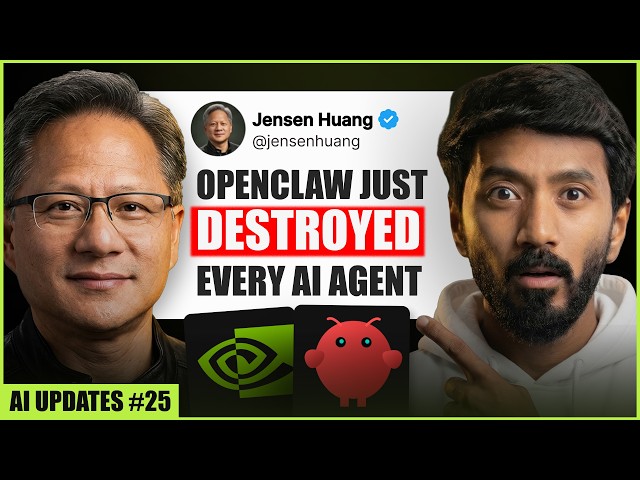
Nvidia CEO Jensen Huang described the mission: shift from AI that answers questions to AI that completes tasks autonomously. Nvidia’s open-source “Open Claw” is laying the groundwork for every software toolfrom Notion to Salesforceto evolve into its own AI-powered worker. The implication: your next subscription may not be a tool, but a full-fledged digital assistant that just gets things done.
9. Claude’s Rapid-Fire Upgrades
Claude pushed four major updates in a single week:
- Massively increased memoryenough to remember every page of an entire book in a chat.
- Co-work dispatchremotely assign tasks from your phone and receive results instantly.
- Co-work projectsClaude can now manage project-specific memory and instructions, keeping context separate for each project.
- Native agent integrationconnect with platforms like Telegram or Discord for autonomous, remote task execution.
10. Surprising Image Model Launches
This week saw two image model releases: MidJourney V8 Alpha with improved speed and text rendering, though still struggling with details like hands; and Microsoft’s new May Image 2, which excels in photo realism and accurate in-image text, ranking in the global top three for image generation models despite its early-stage limitations.
Five Underrated AI Tools You Should Know
- Time Lapse: Real consumer research at a fraction of traditional costs.
- Dex: An AI-powered data analyst for founders to query databases in plain English.
- Blink Claw: One-click deployment of powerful, self-hosted AI agents.
- Cappy: Cloud-based AI that plans, codes, and reviews software autonomously.
- Mothership: Purpose-built AI workspaces for managing and editing autonomous agents.
Hands-On With Google Stitch: Vibe Design in Action
Stitch by Google is the breakout star for anyone wanting to prototype digital products, fast. Describe your app, choose your design mood, and Stitch drafts pixel-perfect screens with color palettes, flows, and even voice-driven edits. Import design systems from sites you admire; customize everything conversationally; and export directly to Figma, AI Studio, or clean HTML/CSS. What once took professionals weeks and thousands of dollars can now be done by anyone in minutesno coding required.
How AI Will Impact Your Job: The Data Is In
OpenAI co-founder Andrej Karpathy analyzed how AI exposure varies by job, based on 342 real roles and 143 million US workers. The findings are stark: desk-based professionals (especially those in software, data, or transcription) face the highest risk of automation, while physical and trades-based roles remain safestfor now. Surprisingly, higher-paying white-collar jobs are more exposed to AI than lower-paid, entry-level work. The core takeaway? If the majority of your tasks can be done on a screen, AI is rapidly advancing into your territory.
Conclusion
This week’s tidal wave of AI updates signals not just technological progress, but a fundamental redefinition of how we build, work, and interact with digital systems. With predictions of exponential economic growth and the rise of digital agents, professionals must stay agile and embrace these tools to stay ahead. Whether you are a business leader, developer, or knowledge worker, understanding these rapid changes is now essential for future-proofing your skills and strategies.
Note: This blog is written and based on a YouTube video. Orignal creator video below: