

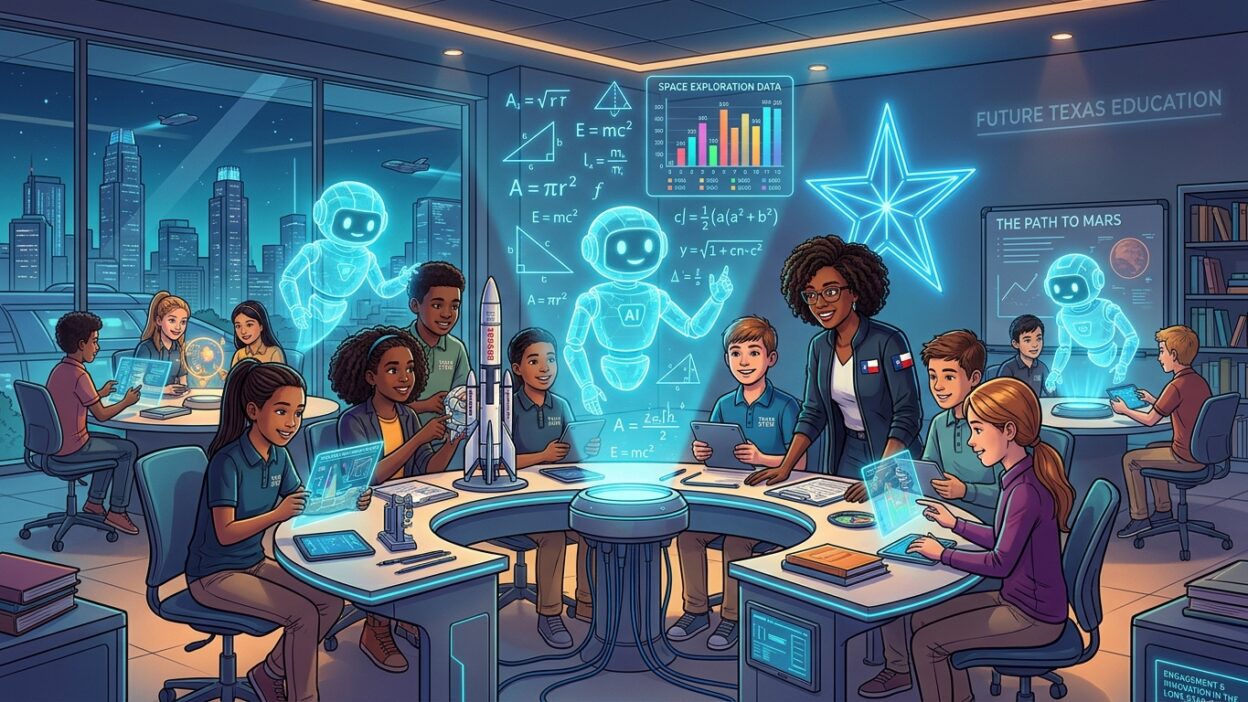
Texas public schools and universities are ditching blanket bans on artificial intelligence, choosing instead to integrate AI as a practical classroom co-pilot. By using tools to cut teacher prep time and personalize student practice, educators are proving that tech enhances instruction without replacing human critical thinking.
Remember late 2022 when ChatGPT first dropped? School districts panicked. Firewalls went up on campus Wi-Fi networks, administrators issued stern warnings, and teachers scrambled to run student essays through unreliable detection software. Everyone worried students would stop writing, thinking, and problem-solving altogether.
Fast forward to now, and Texas schools are showing the country a much smarter path forward. From forward-leaning K-12 districts like Belton and Houston to researchers at UT Austin and Baylor, educators are realizing that banning AI simply does not work. Kids have smartphones in their pockets, and they are already using these tools at home. The real question is not whether AI belongs in schools, but how we guide students to use it responsibly while giving overworked teachers some breathing room.
Key Takeaways: What Texas Is Doing Differently
- Dropping the bans: Schools are shifting focus from catching cheaters to building practical AI literacy.
- Targeting teacher burnout: Teachers use AI tools to generate differentiated practice sets, draft emails, and plan lessons in minutes rather than hours.
- Protecting human reasoning: Classrooms treat AI as a conversational tutor or brainstorming partner, never as a tool to do the actual thinking.
- Ditching flawed detectors: Schools recognize that AI checkers cause false accusations, choosing instead to redesign assignments around student voice and in-class discussions.
Why Banning AI in the Classroom Backfired
Whenever a new technology enters education, the knee-jerk reaction is almost always fear. We saw it decades ago with hand-held calculators, spellcheckers, and Wikipedia. When generative AI arrived, that anxiety peaked.
Texas educators quickly discovered two major flaws with the zero-tolerance approach. First, blocking websites on school laptops accomplished very little because students simply switched to their cellular data. Second, commercial AI detectors proved notoriously inaccurate. They regularly flagged original student essays as bot-written text, creating friction between teachers and honest students.
Rather than policing software they could not control, school leaders decided to bring the conversation out into the open. If students are going to graduate into a workforce that expects them to use AI, shielding them from it during their school years does them a disservice.
How Texas Teachers Are Actually Using AI Today
What does enhancement look like in real classrooms? It is far less flashy than science fiction, but it solves real problems that teachers face every day.
1. Reclaiming Hours on Lesson Planning and Differentiation
Every teacher knows the struggle of tailoring a single lesson for thirty kids with completely different reading levels. A teacher might spend hours rewriting a science article so that struggling readers can grasp the concepts while advanced readers stay engaged.
With AI assistance, a teacher can paste in a complex text and generate three distinct reading levels with accompanying vocabulary questions in under two minutes. They still review, edit, and fact-check everything, but the grunt work vanishes. That leaves more energy for face-to-face coaching.
2. Turning AI into a Socratic Study Partner
Instead of telling AI to “write a 500-word essay about the Alamo,” students are prompted to use tools interactively. For instance, a student can instruct an AI assistant to act as a historical figure or a debate opponent, asking questions that challenge their arguments.
In math and physics, students are learning to feed in their work and ask, “Where did my logic break down in step three?” That turns the software into an on-demand tutor that explains concepts step by step, rather than a shortcut that simply spits out the final answer.
3. Powering Student Projects and Visual Storytelling
At Baylor and across regional districts, students are using generative tools to assist with creative presentations. In history classes, students have used image generators to illustrate family heritage projects or depict scenes from oral histories where no photographs exist. The technology handles the graphic rendering, but the narrative direction, research, and emotional core remain entirely human.
The Pros and Cons of AI in Schools
The Upside (Pros)
- Less teacher fatigue: Automating administrative paperwork and draft planning helps prevent early-career educator burnout.
- Adaptive learning: Kids who feel embarrassed to raise their hand in class can ask questions repeatedly until a concept clicks.
- Real-world preparation: Students learn prompt craftsmanship, critical verification, and ethical awareness before entering college or the job market.
- Accessibility support: Language learners and neurodivergent students benefit from real-time text simplification, speech-to-text, and organizational scaffolds.
The Downside (Cons and Challenges)
- The illusion of learning: Reading a slick, AI-generated explanation can trick students into feeling like they understand a topic without doing the cognitive work to retain it.
- Digital divide issues: Wealthier districts can afford premium, privacy-compliant AI platforms, while underfunded schools risk lagging behind.
- Data privacy concerns: Districts must ensure student data and writing samples are never used to train commercial models without consent.
- Hallucinations: Models still get facts wrong, meaning students need rigorous training in source checking and verification.
The Big Shift: Moving Past Punitive AI Detectors
One of the healthiest developments coming out of Texas school policies is the quiet retirement of automated AI detectors. Many districts have concluded that these algorithms are fundamentally flawed. They penalize non-native English speakers at disproportionate rates and erode trust between teachers and pupils.
The solution is not more surveillance. Instead, teachers are updating how they assess mastery. Many are moving toward in-person oral presentations, collaborative group work, and portfolio-based writing where students document their brainstorming drafts and revisions. When the process of thinking is visible, cheating becomes much harder and far less tempting.
Frequently Asked Questions
Are Texas schools allowing students to use AI for homework?
Policies vary by district, but the general trend allows AI as a brainstorming, outlining, and tutoring tool, provided students disclose their use. Submitting AI-generated text as original work remains strictly against academic integrity guidelines.
Will AI reduce the need for classroom teachers?
Not at all. AI cannot build personal relationships, detect emotional distress, guide classroom debates, or inspire curiosity. The consensus across Texas districts is that AI acts as an administrative assistant, letting teachers spend more time on direct human mentorship.
How do teachers prevent students from relying too much on AI?
Teachers emphasize the concept of cognitive friction. If a tool eliminates all mental effort, it gets benched. Educators structure prompts so students must evaluate, critique, or rewrite what the AI generates, keeping the student in the driver’s seat.
What should other school districts take away from the Texas model?
Prohibition does not work. The most effective strategy is establishing transparent policies, training teachers on practical time-saving workflows, and teaching students how to critically question whatever an AI produces.
The Bottom Line
Artificial intelligence is not going to replace teachers, and it should never replace the mental heavy lifting required to learn. By treating AI as a tool to augment human capability rather than a shortcut around effort, Texas schools are showing that tech and traditional learning can coexist quite nicely.

[…] are seeing this transition toward specialized models across multiple industries. Much like how Texas schools use AI to enhance classroom learning through targeted curriculum platforms rather than raw chatbot prompts, finance demands […]