
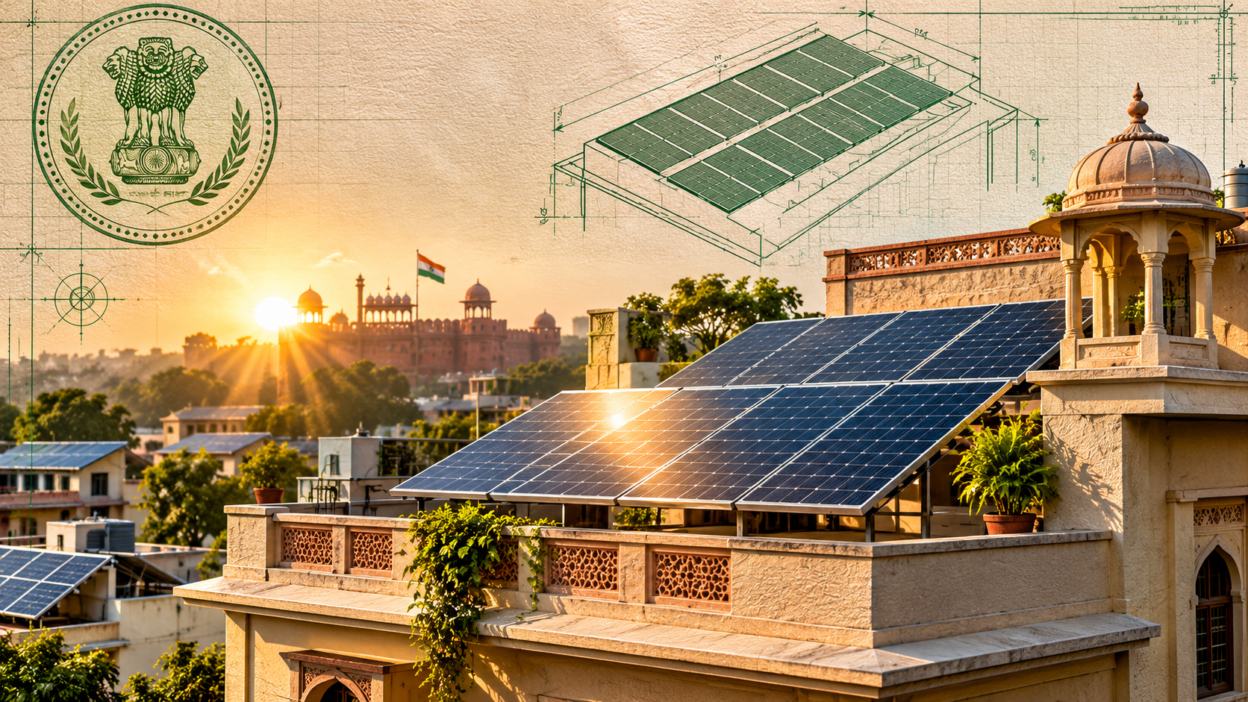
Policy Snapshot (2026 Advisory): The Prime Minister’s Surya Ghar: Muft Bijli Yojana represents a landmark ₹75,021 crore central outlay designed to transition 1 crore Indian residential households to clean distributed solar energy. Applications must be routed exclusively through the national portal (pmsuryaghar.gov.in) with zero registration fees. Ensure your bank account is seeded with Aadhaar in the NPCI mapper before initiating your submission to avoid Direct Benefit Transfer (DBT) disbursement failure.
Introduction: Transforming Indian Household Energy Economics
In an era characterized by escalating power tariffs and rising domestic energy consumption, the PM Surya Ghar Muft Bijli Yojana stands as the Government of India’s most ambitious household energy decarbonization initiative. Approved with an outlay exceeding ₹75,021 crore, the scheme targets empowering 10 million (1 crore) households across India with rooftop solar PV (Photovoltaic) installations. Rather than relying on power bill concessions or untargeted cross-subsidies, this policy transforms ordinary residential consumers into decentralized energy producers, or ‘prosumers’.
By installing grid-connected rooftop solar panels, an average domestic household consuming between 150 and 300 units of electricity per month can effectively reduce its monthly electricity tariff to zero. Furthermore, surplus energy generated during peak sunshine hours is exported back to the regional power distribution company (DISCOM) via bidirectional net meters, earning power credits that carry forward across billing cycles. For middle-class homeowners and fixed-income pensioners, this scheme shifts power from a recurring monthly liability into a capitalized, high-yield infrastructure asset with an internal rate of return (IRR) exceeding 25% to 32% per annum.
Core Benefits & Financial Subsidy Breakdown
The Central Financial Assistance (CFA) structure under the PM Surya Ghar scheme is benchmarked directly against benchmark system capacities. Direct Benefit Transfer (DBT) capital subsidies are credited directly into the consumer’s bank account within 30 days of technical commissioning. Concurrently, nationalized and scheduled commercial banks offer collateral-free solar loans at highly concessional interest rates (pegged at Repo Rate + 0.5%, currently around 7% per annum) under the Jan Samarth framework.
| System Capacity (kW) | Avg. Monthly Generation | Estimated Total Cost | Central Direct Subsidy (DBT) | Net Consumer Outlay | Estimated Monthly Bill Savings |
|---|---|---|---|---|---|
| 1 kW System | 120 – 130 Units | ₹60,000 – ₹65,000 | ₹30,000 | ₹30,000 – ₹35,000 | ₹800 – ₹1,100 |
| 2 kW System | 240 – 260 Units | ₹1,10,000 – ₹1,20,000 | ₹60,000 | ₹50,000 – ₹60,000 | ₹1,600 – ₹2,200 |
| 3 kW System | 360 – 390 Units | ₹1,50,000 – ₹1,65,000 | ₹78,000 | ₹72,000 – ₹87,000 | ₹2,500 – ₹3,500 |
| Above 3 kW (Residential) | 400+ Units | ₹1,80,000+ | ₹78,000 (Capped) | Balance Amount | ₹3,500 – ₹5,000+ |
| Group Housing / RWA | Common Lighting & Pumps | Market Rates | ₹18,000 per kW (Up to 500 kW) | Varies by Society | Community-wide savings |
Financial Advisor Analysis: A standard 3 kW rooftop solar installation requires a net capital commitment of approximately ₹75,000 after the ₹78,000 central DBT subsidy. With average electricity bill savings of ₹3,000 per month (₹36,000 annually), the complete capital investment is fully recovered in approximately 2.1 to 2.5 years. Over the 25-year operational lifespan of Tier-1 solar modules, the net financial surplus generated per household exceeds ₹6,50,000 in post-tax savings.
Strict Eligibility Criteria & Document Checklist
Before initiating your PM Surya Ghar Muft Bijli Yojana apply online workflow, ensure that your residential premises and documentation fully conform to the regulatory parameters set by the Ministry of New and Renewable Energy (MNRE).
Mandatory Eligibility Thresholds
- Indian Citizenship: The primary applicant must be an Indian citizen with full legal title or legal tenancy authorization to the designated residential property.
- Property Type: Installations are permitted strictly on independent residential houses, duplex villas, row houses, or officially registered apartment complexes/Group Housing Societies (GHS/RWA). Purely commercial properties, agricultural connections, and industrial facilities are expressly excluded.
- Active Domestic Meter: An active low-tension (LT) domestic power connection registered in the applicant’s name with the local DISCOM, with no outstanding arrears or litigation.
- Roof Suitability: Unshadowed, structurally sound rooftop area of at least 100 to 130 square feet per 1 kW of intended solar capacity.
- Exclusivity Clause: The applicant must not have claimed any earlier central rooftop solar capital subsidies (such as Phase-II Rooftop Solar Scheme) for the same meter connection.
Comprehensive Document Checklist
- Identity & Address Verification: Aadhaar Card of the registered power consumer (mandatory for biometric/OTP e-KYC).
- Recent Electricity Utility Bill: Copy of the latest domestic electricity bill (issued within the last 60 days) clearly showing the Consumer Account Number (CA/Account ID) and sanctioned load.
- Proof of Roof Rights: Property tax receipt, sale deed, electricity bill matching address, or formal No Objection Certificate (NOC) from co-owners or the apartment RWA.
- Bank Details for Direct Subsidy Transfer: A cancelled cheque or front-page passbook scan of an active, single or joint savings bank account linked with the applicant’s Aadhaar and verified on the NPCI (National Payments Corporation of India) mapper.
- Site Photographs: Clear, wide-angle photographs of the unshaded terrace/roof space showing boundary walls and existing meter box placement.
Common Disqualification Pitfalls
- Discrepancy between the name on the electricity bill and the applicant’s Aadhaar card without submitting an official marriage certificate or legal name-change gazette.
- Attempting to claim the central subsidy on agricultural, institutional, or commercial electricity connections.
- Submission of inactive, dormant, or non-Aadhaar-seeded bank accounts (such as non-DBT enabled NRE/NRO or closed accounts).
- Contracting with un-empaneled, unauthorized freelance technicians whose installations fail DISCOM inspection standards.
Step-by-Step Online Application Walkthrough (pmsuryaghar.gov.in)
Follow this exact official protocol to execute the PM Surya Ghar Muft Bijli Yojana apply online process through the unified national portal without encountering processing bottlenecks.
Phase 1: Consumer Registration & DISCOM Authentication
- Navigate to the official government portal at pmsuryaghar.gov.in and click on the prominent button labeled ‘Apply for Rooftop Solar’.
- Select your respective State and your regional Electricity Distribution Company (DISCOM) from the standardized dropdown menu.
- Input your exact Consumer Account Number as displayed on your monthly power invoice, followed by your mobile number and email ID.
- Complete the real-time Mobile OTP authentication. Once verified, your unique login credentials and application tracking reference number are generated.
Phase 2: Technical Feasibility Approval
- Log in to your consumer dashboard using your registered mobile number and OTP.
- Fill out the comprehensive application form detailing your sanctioned load, proposed rooftop solar capacity (in kW), residential address, and roof dimensions.
- Upload the scanned PDF copies of your latest electricity bill and identity verification document.
- Submit the proposal for DISCOM Technical Feasibility Approval (TFA). Your local distribution engineer will verify that the local distribution transformer capacity can absorb your solar export. This automated or field check typically clears within 7 to 15 business days.
Phase 3: Vendor Selection & Turnkey Installation
- Upon receipt of Feasibility Approval on your dashboard, browse the portal’s directory of Empaneled Solar Vendors registered with your DISCOM.
- Review ratings, product brands, and quotes. Finalize your contract with an empaneled vendor of your choice. Ensure they issue an agreement outlining module efficiency, inverter certifications (BIS/IEC standards), and a mandatory 5-year comprehensive system maintenance guarantee.
- The vendor completes the civil mounting, panel installation, earthing arresters, inverter cabling, and AC/DC safety distribution boxes.
Phase 4: Net Meter Installation & Technical Inspection
- Following complete physical installation, the vendor submits a formal Work Completion Report and plant photographs on the portal.
- Apply through the same dashboard for Net Metering Integration. A DISCOM junior engineer will visit your premises to inspect system safety, verify bidirectional functionality, and install the certified net meter.
- Once verified, the DISCOM generates and uploads the official Commissioning Certificate directly to the national portal.
Phase 5: Bank Account Seeding & Subsidy Release
- Log back into your dashboard, navigate to the ‘Claim Subsidy’ section, and enter your bank account details along with an image of a cancelled bank cheque.
- Ensure the bank account name matches your Aadhaar and portal profile.
- Click Submit. The system initiates an automated automated penny-drop verification.
- Your direct financial subsidy (up to ₹78,000) is credited straight into your bank account via PFMS/DBT within 30 days of certificate approval.
Offline Application Alternative: CSC & Bank Helpdesks
For rural applicants, senior citizens, or individuals lacking consistent broadband access, the Ministry has integrated comprehensive assisted-filing channels across India.
1. Common Service Centers (CSC Digital Seva Kendras)
Applicants can visit any nearest rural or semi-urban Common Service Center (CSC). Village Level Entrepreneurs (VLEs) are authorized and trained to handle the complete onboarding, document digitization, and photo uploads on the official national portal for a nominal, government-regulated service fee of ₹20 to ₹50. Ensure you carry your physical Aadhaar card, electricity bill, and bank passbook to the kiosk.
2. Nationalized Bank Branches & Jan Samarth Assistance
If you intend to avail yourself of the concessional collateral-free rooftop solar loan, visit the retail loan desk of public sector banks including the State Bank of India (SBI), Punjab National Bank (PNB), Bank of Baroda, or Canara Bank. Bank loan officers can assist you in processing both the Jan Samarth Portal loan pre-sanction and the initial Surya Ghar portal consumer registration simultaneously.
Crucial Warnings & Scam Alerts
CAUTION , FRAUD ALERT: The Ministry of New and Renewable Energy (MNRE) has issued strict warnings regarding fraudulent websites, mobile applications (APKs), and fake intermediaries promising guaranteed approvals or demanding upfront processing fees. Note the following non-negotiable security rules:
- Zero Government Application Fee: The official portal (pmsuryaghar.gov.in) charges ₹0 (Zero Rupees) for registration, technical application submission, or subsidy processing.
- Never Pay Third-Party Intermediaries: Do not pay any cash or digital transfers to freelance agents claiming to be ‘Government Solar Officers’. Payments should only be made directly to officially empaneled vendors under formal milestone contracts.
- Beware of Fake APKs: Never download application APKs sent via WhatsApp, SMS, or Telegram claiming to be the ‘PM Surya Ghar App’. Always use the official portal or verified Google Play Store links provided by the National Informatics Centre (NIC).
- Validate Empanelment: Never purchase solar panels from unvetted contractors without verifying their live registration on your state DISCOM’s authorized vendor list inside the national portal.
Smart Financial Integration: Inverters, Batteries & Net Metering
Achieving true zero-bill status and optimizing household financial returns requires careful selection of equipment. While the government subsidy is tied to grid-tied rooftop systems, homeowners can customize their installations for superior durability and grid independence.
1. Best Solar Inverters (String vs. Hybrid MPPT)
The solar inverter is the computational brain of your rooftop setup. Under standard net-metering regulations, a grid-tied string inverter with Dual Maximum Power Point Tracking (MPPT) delivers peak conversion efficiencies of 97% to 98.5%. However, if your locality experiences frequent power grid outages, standard on-grid inverters shut down automatically for anti-islanding safety. Consider choosing an MNRE-approved Hybrid Inverter that can synchronize with the grid when available while seamlessly diverting generated power to emergency home circuits during blackouts.
2. Battery Storage Systems (LiFePO4 Integration)
While the central subsidy covers the grid-tied PV modules and balance-of-system components, integrating a dedicated Lithium Iron Phosphate (LiFePO4) Battery Bank drastically enhances domestic energy security. Unlike outdated lead-acid units, modern 48V/51.2V LiFePO4 batteries offer 4,000 to 6,000 charging cycles (10+ years operating life) at 90% Depth of Discharge (DoD). This ensures that night-time consumption draws from stored daytime solar energy rather than pulling from higher peak-time utility tariff slabs.
3. Rooftop Net Metering Kits & Smart Energy Monitors
Insist on an advanced bidirectional net metering kit equipped with RS-485 Modbus communications and integrated IoT Wi-Fi monitoring. Real-time smartphone applications allow you to track instantaneous solar generation, direct household consumption, and grid export figures. This financial visibility helps you program high-load appliances (such as washing machines, dishwashers, and water heaters) to run during peak solar generation hours (11:00 AM to 3:00 PM), minimizing system losses and maximizing return on equity.
Frequently Asked Questions (FAQ)
What happens if my monthly consumption is higher than 300 units?
If your household consumes more than 300 units monthly, your solar system will offset the initial 300 to 360 units (depending on installed capacity), and you will only be billed by your DISCOM for the net marginal consumption above that generation threshold at normal slab tariffs. Your maximum central subsidy remains capped at ₹78,000 for systems of 3 kW or greater.
Is a tenant eligible to apply for PM Surya Ghar on rented premises?
Tenants can only apply if the domestic electricity meter is officially registered in their name, or if the property owner issues a formal registered legal consent and No Objection Certificate (NOC). However, because rooftop solar systems involve permanent structural fixtures and long-term 25-year asset lifespans, the scheme is optimized and recommended primarily for residential property owners.
How long does it take for the ₹78,000 subsidy to reach the bank account?
Following the successful installation of the bidirectional net meter and the DISCOM engineer’s upload of the formal Commissioning Certificate on the portal, the Direct Benefit Transfer (DBT) is cleared through the Public Financial Management System (PFMS) and credited into your Aadhaar-seeded bank account within 30 working days.
Can I expand my solar rooftop system capacity in the future?
Yes, you can apply for an enhancement of your sanctioned solar capacity at a later date by submitting a capacity extension request on the national portal and obtaining fresh DISCOM feasibility approval. However, please note that the central capital subsidy is granted as a one-time financial assistance mechanism up to the maximum ceiling of ₹78,000 per registered consumer.
Conclusion & Immediate Action Checklist
The PM Surya Ghar Muft Bijli Yojana provides an unprecedented structural opportunity for Indian households to decouple themselves permanently from rising power tariffs while capturing an immediate ₹78,000 government grant. By transitioning your roof into a clean energy asset, you secure predictable utility savings, increase your home’s capital resale value, and actively contribute to India’s national climate objective of reaching 500 GW of non-fossil capacity.
Your 5-Step Action Checklist to Apply Today:
- Verify that your electricity bill name matches your Aadhaar card spelling exactly.
- Check that your bank account is active and seeded on the NPCI mapper for DBT transfers.
- Inspect your roof space to ensure clear, unshaded southern exposure of at least 250 to 300 sq. ft.
- Visit pmsuryaghar.gov.in and complete your initial consumer registration.
- Review quotes exclusively from DISCOM-empaneled vendors to guarantee project subsidy compliance.